Lumber — Dimensional, Hardwood, Plywood & More
Partner lumber yards and distributors in our Chicago-area network supply framing lumber, dimensional lumber, engineered wood products, sheathing, plywood, and specialty hardwoods. Whether you are building a new home, framing an addition, or crafting custom furniture, tell us the species, grades, and quantities you need and we will pass your request to suppliers who can quote it. Ask suppliers about grade stamps, moisture content, and how material is stored, and confirm with your designer or the Chicago Department of Buildings what your project requires. Partner suppliers can often help you select the right species, grade, and treatment for your application and budget.
Request a Quote
Dimensional & Framing Lumber
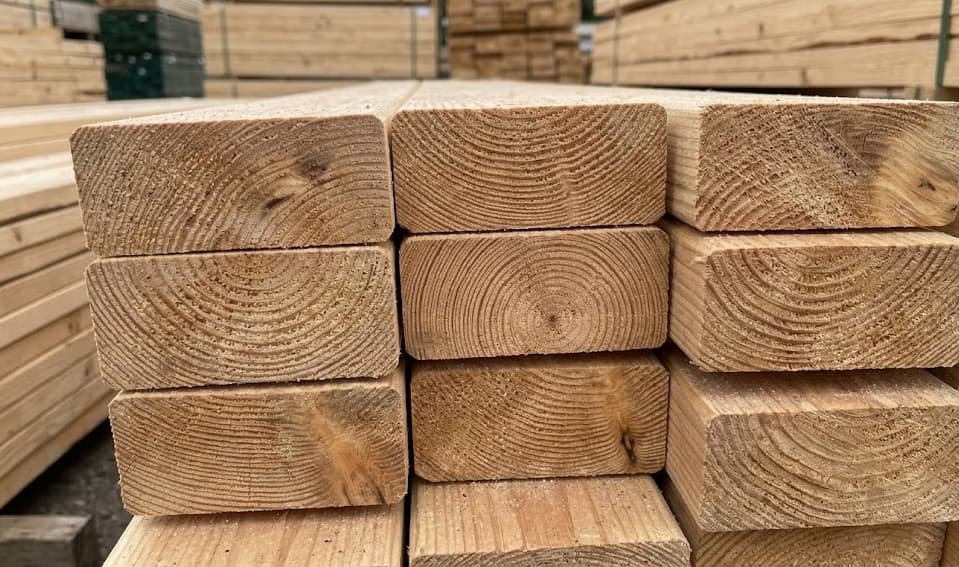
Dimensional lumber is the backbone of residential and light commercial construction. Partner suppliers in our network offer kiln-dried SPF (Spruce-Pine-Fir) and Douglas Fir framing lumber in standard sizes from 2x2 through 2x12, as well as 4x4, 4x6, and 6x6 posts. Lumber stamped KD (kiln-dried) has been dried to 19% moisture content or less, which reduces shrinkage, warping, and nail pops after installation.
Suppliers can quote the full range of grades commonly specified on Chicago-area job plans. #2 and Better SPF is a common grade for wall, floor, and roof framing, while Stud Grade 2x4s and 2x6s are the economical workhorse for standard wall construction. Select Structural and #1 grade lumber are available for applications where higher bending strength or fewer defects are specified by the engineer of record.
Douglas Fir is available when projects call for stronger, denser framing stock. It is frequently specified for beams, ridge boards, and long-span headers where its superior structural values allow smaller member sizes or longer spans compared to SPF. Ask partner suppliers about #2 and Better grades in 2x6 through 2x12 dimensions and the lengths they can supply.
Hardwood Lumber
Woodworkers, cabinet shops, and finish carpenters throughout the Chicagoland area can request quotes from partner suppliers for domestic hardwoods including Red Oak, White Oak, Hard Maple, Cherry, Walnut, Poplar, and Ash in 4/4 through 8/4 thicknesses. Boards are available rough-sawn for those who prefer to surface their own stock, or surfaced four sides (S4S) for projects where convenience is a priority.
Hardwood lumber is graded under the National Hardwood Lumber Association (NHLA) system. FAS (First and Seconds) is the highest grade, yielding long, wide, clear-face cuttings ideal for furniture panels and tabletops. #1 Common provides an excellent balance of clear wood and value, well-suited for cabinet parts, shelving, and millwork. Hardwoods are typically sold by the board foot, and some suppliers will hand-pick boards to your specifications for critical projects.
For woodworkers and fine furniture makers, some suppliers in our network carry figured and specialty woods such as quartersawn White Oak, curly Maple, and live-edge Walnut slabs. Availability changes quickly, so describe what you are looking for in your quote request.
Plywood & Panels
Partner suppliers offer a broad selection of plywood and panel products for structural, cabinetry, and specialty applications. Structural panels include CDX plywood for roof and wall sheathing, fire-retardant treated plywood for commercial fire-rated assemblies, and marine-grade plywood for applications requiring maximum moisture resistance. OSB (Oriented Strand Board) sheathing and subflooring panels are also available in standard 4x8 sheets and 4x8 tongue-and-groove subflooring.
For interior projects, cabinet-grade plywood includes Birch, Maple, Oak, and Walnut veneered panels in 1/4-inch through 3/4-inch thicknesses. Suppliers offer both pre-finished and unfinished options, including sheets with a hardwood face on one or both sides. Baltic Birch plywood with its void-free multi-ply construction is available for drawer boxes, jig-making, and projects that require exceptional edge quality.
Specialty panels such as MDF (Medium Density Fiberboard), hardboard, and melamine-coated particleboard round out the selection. MDF machines cleanly and takes paint beautifully, making it the standard choice for painted cabinet doors, raised panels, and decorative applications.
Pressure-Treated Lumber
Pressure-treated lumber is essential for any outdoor or ground-contact application in the Chicago area. Treated lumber is commonly Southern Yellow Pine in all standard dimensional sizes, treated to either UC3B (above-ground) or UC4A (ground-contact) retention levels. Chicago's freeze-thaw cycles and wet spring conditions make proper treatment selection critical to the longevity of decks, fences, retaining walls, and landscape structures.
Partner suppliers can quote treated lumber from 2x4 through 2x12, along with 4x4, 4x6, and 6x6 treated posts for deck foundations, fence posts, and structural supports. Pressure-treated decking includes both standard 5/4x6 radius-edge deck boards and 2x6 flat stock. Most residential treated lumber today uses copper-based preservatives such as MCA (Micronized Copper Azole) or ACQ (Alkaline Copper Quaternary); use hot-dip galvanized or stainless steel fasteners rated for treated lumber.
Engineered Wood Products
Engineered wood products deliver superior strength, consistency, and span capabilities compared to solid sawn lumber. LVL (Laminated Veneer Lumber) beams come in standard depths from 9-1/4 inches through 18 inches and thicknesses of 1-3/4 inches and 3-1/2 inches. LVL beams are the go-to solution for garage door headers, load-bearing wall headers, and structural beams where long spans and heavy loads need to be carried without intermediate support.
I-joists are available in a range of depths for floor and roof framing. Their lightweight design makes them easy to handle, while their manufactured precision eliminates the crowning, twisting, and dimensional inconsistency that can occur with solid sawn joists. The result is a flatter, quieter floor system that goes up faster on the jobsite.
Glulam beams suit exposed architectural applications where the warmth of real wood is desired along with engineered performance, and engineered rim boards and structural headers are also available through partner suppliers. Many suppliers can assist with product selection and point you to manufacturer engineering support for complex structural applications.
Popular Lumber Products
Below is a sample of commonly requested lumber products. Request a quote and we'll pass your request to partner suppliers for current availability and pricing.
2x4 SPF Stud Grade 8ft
Kiln-dried spruce-pine-fir studs, the backbone of residential and light commercial framing.
2x6 #2 Douglas Fir
Premium Douglas Fir dimensional lumber for structural framing, floor joists, and rafters.
2x10 #2 SPF
Structural-grade dimensional lumber for floor joists, headers, and beams in residential construction.
2x12 #2 SPF
Heavy-duty dimensional lumber for ridge boards, long-span headers, and engineered applications.
4x4 Pressure-Treated Post
Ground-contact rated posts for decks, fences, pergolas, and structural support applications.
6x6 Pressure-Treated Post
Heavy-duty structural posts for deck foundations, pergola supports, and commercial applications.
3/4" CDX Plywood
Exterior-grade plywood for roof sheathing, wall sheathing, and general construction use.
7/16" OSB Sheathing
Oriented strand board for wall and roof sheathing, meeting structural panel requirements.
3/4" Birch Plywood
Cabinet-grade birch plywood with a smooth, paintable face for cabinetry and built-ins.
LVL Beam 1-3/4" x 11-7/8"
Laminated veneer lumber for long-span headers, beams, and load-bearing applications.
Red Oak 1x6 S4S
Surfaced four sides red oak board for trim, shelving, furniture, and millwork projects.
Western Red Cedar 1x6
Naturally rot-resistant cedar boards ideal for closet lining, siding, and outdoor trim.
5/4x6 Pressure-Treated Decking
Radius-edged decking board treated for above-ground use on residential deck projects.
Walnut 4/4 Rough Sawn
Premium American black walnut lumber for furniture, cabinetry, and high-end woodworking.
Hard Maple 4/4 Rough Sawn
Dense, durable hard maple for butcher blocks, countertops, and fine woodworking.
What Partner Suppliers Can Offer
- ✓Kiln-dried SPF and Douglas Fir framing lumber in all standard dimensions
- ✓Pressure-treated lumber rated for ground contact and above-ground applications
- ✓Premium hardwoods including red oak, white oak, maple, cherry, and walnut
- ✓Engineered wood products: LVL beams, I-joists, and glulam headers
- ✓CDX, ACX, and marine-grade plywood in multiple thicknesses
- ✓OSB sheathing and subflooring panels
- ✓Cedar and redwood boards for outdoor and decorative applications
- ✓Graded, stamped lumber for structural applications (confirm requirements for your project)
Dimensional Lumber Size Chart
One of the most common sources of confusion for homeowners and first-time builders is that dimensional lumber is sold by its nominal size, which is larger than its actual size. The nominal size reflects the rough-sawn dimensions before the board is kiln-dried and planed smooth. After drying and surfacing, each board is smaller than its stated size. The chart below shows the actual dimensions you will receive for each common nominal size.
| Nominal Size | Actual Size (inches) | Actual Size (mm) | Common Uses |
|---|---|---|---|
| 2x4 | 1.5" x 3.5" | 38 x 89 | Wall studs, blocking, light framing |
| 2x6 | 1.5" x 5.5" | 38 x 140 | Exterior wall studs, rafters, floor joists |
| 2x8 | 1.5" x 7.25" | 38 x 184 | Floor joists, rafters, headers |
| 2x10 | 1.5" x 9.25" | 38 x 235 | Floor joists, stair stringers, headers |
| 2x12 | 1.5" x 11.25" | 38 x 286 | Long-span joists, ridge boards, large headers |
| 4x4 | 3.5" x 3.5" | 89 x 89 | Fence posts, deck posts, porch columns |
| 6x6 | 5.5" x 5.5" | 140 x 140 | Heavy deck posts, beams, structural columns |
Pro Tip: When planning your project, always use actual dimensions for layout calculations. A wall framed with 2x4 studs is actually 3.5 inches deep, not 4 inches. This matters for door jamb extensions, electrical box depths, and drywall returns.
How Board Feet Work
Board feet is the standard unit of measure for purchasing hardwood lumber and some specialty softwood products. Understanding the formula allows you to accurately estimate quantities and communicate with lumber suppliers. One board foot equals a volume of wood that is 1 inch thick, 12 inches wide, and 12 inches long — equivalent to 144 cubic inches of wood.
The Board Foot Formula
Board Feet = (Thickness in inches × Width in inches × Length in feet) ÷ 12
Or equivalently: (Thickness × Width × Length in inches) ÷ 144
Example Calculations
Example 1: 4/4 Red Oak board, 6" wide, 8 feet long
Board Feet = (1 × 6 × 8) ÷ 12 = 4 board feet
Example 2: 8/4 (2-inch) Walnut board, 10" wide, 6 feet long
Board Feet = (2 × 10 × 6) ÷ 12 = 10 board feet
Example 3: 6/4 (1.5-inch) Hard Maple board, 8" wide, 10 feet long
Board Feet = (1.5 × 8 × 10) ÷ 12 = 10 board feet
When ordering hardwood, keep in mind that board foot pricing reflects the rough-sawn dimensions before surfacing. If you order S4S (surfaced four sides) lumber, you pay for the pre-surfacing board footage but receive a board that is slightly thinner and narrower after planing. A 4/4 board surfaced to 13/16-inch is still billed as 4/4 (one inch). Hardwood pricing depends on species, grade, and market, and comes by quote from partner suppliers, many of whom can help you calculate board footage.
Structural Lumber Grades for Chicago Projects
Chicago has its own building code, and structural lumber used in load-bearing applications needs the right grade and species for its function. Selecting the wrong grade can result in a failed inspection and costly rework. Here is how grades are commonly used in framing; confirm current requirements with the Chicago Department of Buildings, your local building department, or your design professional.
| Application | Common Grade | Typical Size | Notes |
|---|---|---|---|
| Wall Studs | Stud Grade or #2 | 2x4 or 2x6 | Stud Grade is graded for vertical loads only |
| Floor Joists | #2 and Better | 2x8, 2x10, 2x12 | Size per span table; max span varies by species |
| Ceiling Joists | #2 and Better | 2x6, 2x8 | Size depends on span and attic use |
| Rafters | #2 and Better | 2x6, 2x8, 2x10 | Size depends on span and roof loads; confirm with your designer |
| Headers & Beams | #1 or Select Structural | Doubled 2x8 to 2x12, or LVL | Engineered alternative: LVL beam per engineer's design |
| Sill Plates | #2 PT (ground contact) | 2x6 | Pressure-treated; confirm anchoring requirements |
Span Tables: Model building codes include span tables that specify the maximum allowable span for each lumber size, grade, and species at a given spacing (12", 16", or 24" on center). Always consult the appropriate span table when selecting joist and rafter sizes, and confirm which tables apply in Chicago. Your designer or a partner supplier can help you select the correct lumber.
Species Comparison for Common Projects
Choosing the right wood species for a project is just as important as choosing the right grade and size. Different species have distinct structural properties, workability characteristics, and cost profiles. Here is a quick reference to help you select the best species for your application.
SPF (Spruce-Pine-Fir)
Best for: General framing
The workhorse of residential construction. Lightweight, economical, and widely used for wall studs, floor joists, and roof rafters at standard spans. Kiln-dried SPF is straight, consistent, and easy to nail. This is the species behind most 2x4 and 2x6 framing lumber.
Douglas Fir
Best for: Beams & heavy structural
Denser and stronger than SPF, with higher allowable bending stress and stiffness values. Choose Doug Fir for long-span headers, ridge boards, structural beams, and applications where you need to carry heavy loads or span farther between supports. Typically costs more than SPF but delivers measurably better performance.
Pressure-Treated SYP
Best for: Ground contact & outdoor
Southern Yellow Pine treated with MCA or ACQ preservatives is the usual choice for sill plates, deck substructures, fence posts, retaining walls, and any wood in direct contact with soil or concrete. Choose UC4A rating for ground contact, UC3B for above ground. SYP's open cellular structure absorbs preservatives deeply and uniformly.
Western Red Cedar
Best for: Outdoor & appearance
Naturally rot- and insect-resistant without chemical treatment. Ideal for deck surfaces, fencing, siding, outdoor furniture, and any visible outdoor application where a warm, natural appearance is desired. Lightweight, dimensionally stable, and takes stain beautifully. Higher cost but lower maintenance than untreated alternatives.
Red Oak & White Oak
Best for: Flooring & fine woodwork
Red Oak is one of the most popular hardwood flooring species in Chicago homes, offering excellent hardness (Janka 1,290), prominent grain pattern, and good stain acceptance. White Oak is harder (Janka 1,360), more water-resistant, and ideal for furniture, cabinetry, and exterior applications. Both take stain and finish beautifully.
Poplar
Best for: Paint-grade trim & millwork
A domestic hardwood that machines cleanly, resists warping, and takes paint exceptionally well. More dimensionally stable than pine, making it ideal for wide trim boards, built-in cabinetry, and millwork that will be painted. More affordable than oak or maple while offering superior stability compared to softwoods.
Frequently Asked Questions About Lumber
Ready to Order Lumber?
Tell us what you need and we'll pass your request to partner lumber suppliers in the Chicago area for pricing and availability.